
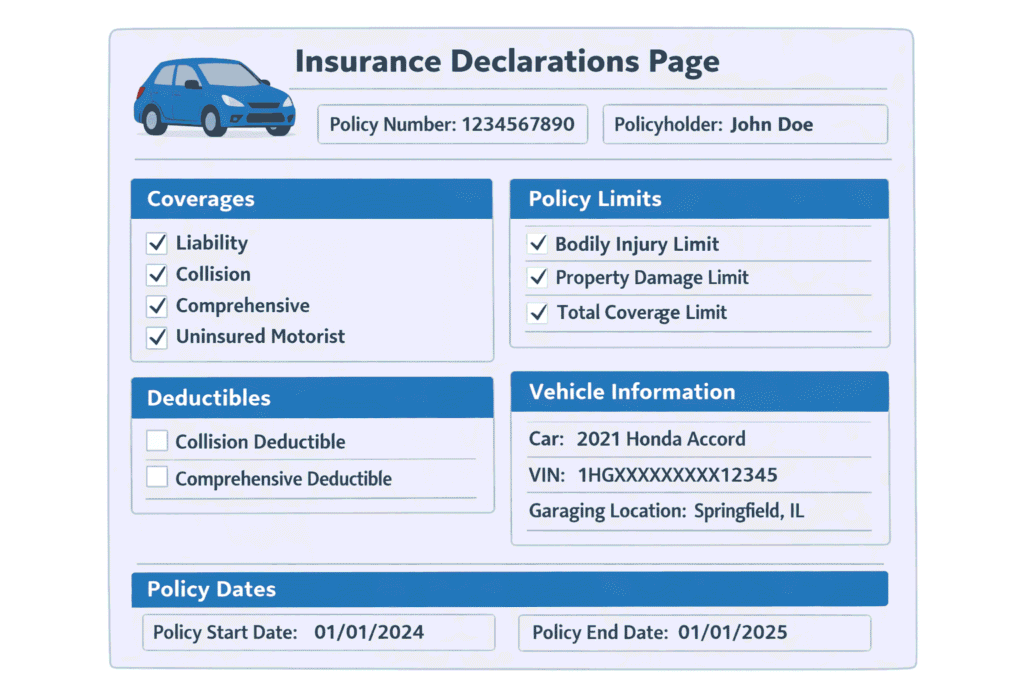
Car insurance declarations page is the document that summarizes what your policy includes coverages, limits, deductibles, vehicles, and policy dates. Many people only see a bill, a proof-of-insurance card, or a renewal email. But the declarations page (often called the dec page) is the quickest place to confirm what protection you really have.
If you have ever wondered what “full coverage” really means, why your premium changed, or what your deductibles and limits are, the declarations page is usually the fastest place to look.
If you’re not sure what these terms mean in the first place, start with What Is Car Insurance?.
In this guide, you’ll learn what a declarations page is, what information it includes, where to find it, and how to use it to understand your car insurance coverage.
What is a declarations page (dec page)?
A declarations page is a summary of your car insurance policy. It lists the key details of your coverage, including who is insured, which vehicles are covered, which coverages are included, and your policy limits and deductibles.
It is not the full contract. The full policy contains many pages of definitions, exclusions, and rules. The declarations page is the quick “overview” that helps you confirm what protection you have.
How the dec page helps during a claim
After an accident, the declarations page helps you confirm the coverages you have, the limits that apply, and the deductibles you may owe. It can also show whether collision and comprehensive are included, which matters when the question is “who pays” for damage to your own vehicle.
What the declarations page usually shows
While layouts vary by company and state, most dec pages include the categories below.
1) Policyholder and driver information
This section usually lists the named insured (policy owner) and sometimes other drivers on the policy. It may also show your address and garaging location.
2) Policy number and effective dates
You’ll typically see the policy number and the coverage period (start and end dates). This matters if you need proof of coverage for registration, a lender, or a claim timeline.
3) Vehicles covered
This section usually lists each covered vehicle (year, make, model, VIN). If a vehicle is missing or incorrect, it can create problems later.
4) Coverages included
Your dec page shows which coverages you have, such as:
- Liability (injury/property damage you cause to others)
- Collision (crash damage to your car)
- Comprehensive (non-collision damage like theft or hail)
- Uninsured/underinsured motorist (where included/required)
- MedPay or PIP (medical coverage, depending on state)
If you want a broader overview of how these coverages work together, see What Does Car Insurance Cover?.
5) Limits (how much the policy can pay)
For many coverages, the dec page lists limits—often in formats like 25/50/25 for liability. Limits are the maximum amounts the policy can pay for a covered claim, depending on the coverage.
If limits look confusing, this guide explains them step by step: Car Insurance Policy Limits.
6) Deductibles (what you pay first)
Your dec page usually shows deductibles for collision and comprehensive. A deductible is what you pay out of pocket before insurance pays the rest of a covered repair.
To understand how deductibles work, see What Is a Car Insurance Deductible?.
7) Premium and payment summary
Many declarations pages show the premium breakdown for the policy term. This may include discounts, fees, and total premium (but the format varies). If you’re trying to understand why cost changes, see What Affects Car Insurance Cost?.
Where to find your declarations page
Most people can find their declarations page in one of these places:
- Your insurer’s online account or mobile app (look under “Policy Documents”)
- A renewal email or PDF attachment
- Paper mail packet (for some policies)
- Through your agent or customer service (ask for “Declarations” or “Policy Declarations”)
Common questions about the declarations page
These are quick answers to common questions people search after they hear “dec page” or need to confirm coverage fast.
Is the declarations page the same as the full policy?
No. The declarations page is a summary. The full policy includes detailed definitions, exclusions, and rules that control how claims are handled.
Does the declarations page show if I have “full coverage”?
It usually won’t literally say “full coverage” because that is not an official policy type. But if your dec page lists collision and comprehensive (along with liability), that is what many people mean by “full coverage.”
Can my declarations page change at renewal?
Yes. Renewal documents can show changes to vehicles, drivers, coverages, deductibles, limits, discounts, or fees. That is one reason it’s smart to review the dec page each renewal period.
What if something is wrong on my dec page?
If your vehicle, address, listed drivers, or usage details are incorrect, contact the insurer or agent and ask how to correct it. Incorrect information can cause pricing surprises and may create claim issues depending on the situation.
Does the declarations page show my deductible?
In many policies, yes—especially for collision and comprehensive. If you don’t see it, check the rest of your policy documents or ask for a copy that includes the deductible details.
Important to Know
Car Policy Answers is an independent educational website. We do not sell insurance, provide quotes, or recommend insurance companies.
This article is intended for general educational purposes only. Insurance laws and coverage requirements vary by state, and the facts of a claim matter.